Advanced Minimally Invasive Hysterectomy:
Minimal Visible Scarring.
Ambulatory surgical care from true pioneer Dr. Kevin Stepp. Unhurried concierge recovery that gets you back to your life in days, not weeks. Located in Charlotte and serving patients nationwide.
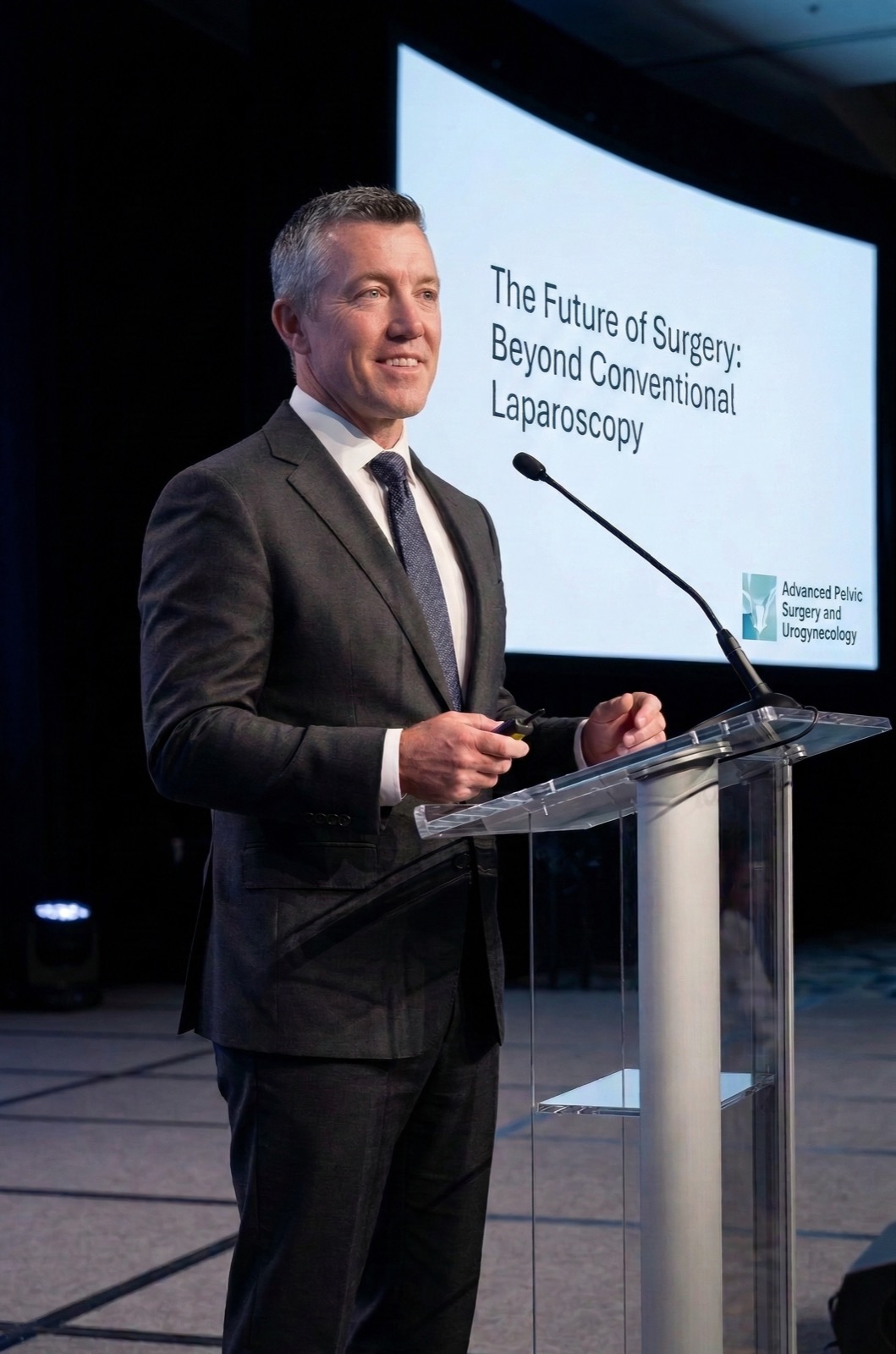
Defining the Minimally Invasive Standard
When you choose Dr. Kevin Stepp, you are not just choosing a surgeon who uses advanced technology; you are choosing the surgeon who helped invent the techniques.
The Robotic Genesis
While still a resident at the Cleveland Clinic, Dr. Stepp participated in early robotic hysterectomy work on a human cadaver, part of the formative era of robotic gynecologic surgery.
A World First in SILS
To Dr. Stepp's knowledge, he became the first surgeon to utilize the purpose-built multi-channel port (Triport) for Single-Incision Laparoscopic Surgery (SILS), allowing selected cases to be performed through a hidden umbilical incision.
Total Architectural Autonomy
Proving unmatched surgical independence, Dr. Stepp was the first to perform a solo robot-assisted single-incision hysterectomy (utilizing ViKy robotic assistance), operating with master-level precision without relying on a large operative team.
The Robot is a Tool, Not a Crutch.
In modern gynecology, the robotic platform is heavily marketed by hospitals. While robotic surgery undeniably offers excellent clinical benefits—such as precise microsurgical capabilities and 3D ultra-high-definition imaging—in many standard practices, it has become a crutch to compensate for a lack of advanced fellowship training in pure laparoscopic skills.
As a master of surgical architecture, Dr. Stepp is proudly platform independent. He commands the full spectrum of minimally invasive techniques.
For the vast majority of hysterectomies, he prefers advanced Single-Incision Laparoscopy (SILS), allowing the entire surgery to be performed through a single micro-incision hidden deep within the umbilicus (belly button) to minimize visible scarring. However, for highly complex pathologies, he seamlessly deploys advanced conventional multiport laparoscopy—with or without robotic assistance—to safely extract the disease.
We utilize the robot only when it is the unequivocally superior tool for your specific, complex anatomy—never because it is the only tool we know how to use.
For a broader perspective on the future of surgical robotics, read Dr. Stepp’s essay, “Why Robots Won’t Take the Surgeon’s Job Anytime Soon.”
Pioneering 3D Flexible Laparoscopy
Dr. Stepp routinely uses flexible 3D ultra-high-definition laparoscopes for complex, non-robotic surgery when that visualization is the right tool for the case. His experience with 3D laparoscopy supports precise dissection without requiring every case to be robotic.
"True surgical mastery means selecting the exact, least-invasive instrument required for your unique anatomy, supporting complete disease removal when anatomically appropriate through the smallest appropriate access points."
— Dr. Kevin SteppThe Stepp SILS Advantage
-
A Single Incision Focus
For the vast majority of cases, the entire procedure is orchestrated through one hidden micro-incision (multiport reserved only for severe complexity).
-
Minimal Visible Scarring
The primary incision is concealed within the umbilicus (belly button) to minimize visible scarring.
-
Master-Level Precision
Executed by a dual-fellowship trained pioneer in both Urogynecology and Complex Benign Gynecology.
-
Regenerative Recovery Support
Includes a personalized pathway designed to actively down-regulate inflammation and accelerate cellular healing.
The Anatomy of a Precision Hysterectomy
A hysterectomy can be the right treatment option for many uterine diseases, but it should be planned with pelvic support, ovarian function, recovery, and long-term anatomy in mind.
Ovarian Preservation
The greatest fear surrounding a hysterectomy is forced menopause. A hysterectomy is the removal of the uterus—not the ovaries. Dr. Stepp fiercely protects your ovarian blood supply during surgery, ensuring your hormonal health and natural endocrine function remain completely intact.
Pelvic Floor Reconstruction
This is the Urogynecology difference. Many standard hysterectomies compromise the structural integrity of the pelvis, leading to prolapse years later. Dr. Stepp simultaneously performs advanced ligament suspension techniques to reinforce the vaginal vault and completely stabilize your pelvic floor.
Fallopian Tube Removal
While the ovaries are preserved, modern medical standards dictate the complete removal of the fallopian tubes (opportunistic salpingectomy) during a hysterectomy. This seamless step drastically reduces your lifetime risk of developing ovarian cancer without affecting your hormones.
Mastering the "Impossible" Cases
The National Second Opinion Destination
Have you been told your uterus is "too large" or your pathology is "too severe" for minimally invasive surgery? Many OB/GYNs frequently recommend large, painful open abdominal incisions (laparotomy) because they lack advanced surgical training. Based in Charlotte, NC, Dr. Kevin Stepp serves as a complex referral center, routinely and safely performing minimally invasive, outpatient surgery on patients who were told it was impossible locally.
Complex Benign Pathology
Dr. Stepp's dual-fellowship training in Urogynecology and Complex Benign Gynecology supports careful planning in complex surgical environments. Massive fibroids, severe deep infiltrating endometriosis, and frozen pelvis cases require meticulous dissection with attention to vital organs.