Advanced Adenomyosis
Treatment & Uterine Preservation
Beyond "heavy periods." Dr. Kevin Stepp offers advanced diagnostic and surgical care for adenomyosis in Charlotte, NC — including MRI-guided evaluation, Acessa RF ablation for selected patients who want to preserve their uterus, and minimally invasive hysterectomy when appropriate.
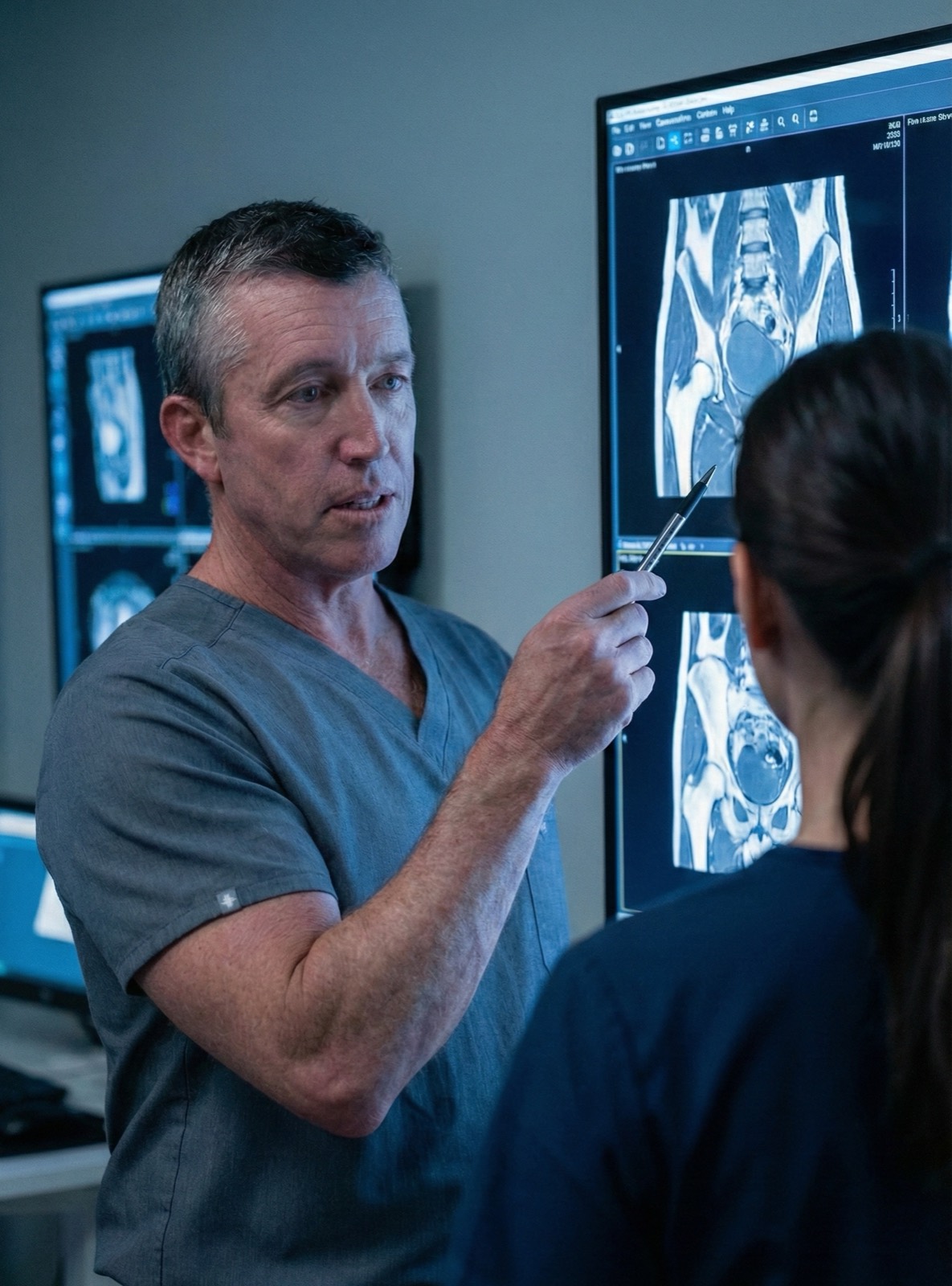
The "Sand in a Sponge" Reality
Adenomyosis occurs when endometrial-like tissue infiltrates the muscular wall of the uterus — the myometrium. Unlike fibroids, which are distinct encapsulated tumors that can often be surgically excised, adenomyosis is diffuse and infiltrative. It invades the muscle fibers the way sand permeates a sponge, making it impossible to simply "cut out" while preserving the uterus through standard methods.
— Kevin Stepp, MD, FACOG, URPS
This condition is now understood through the Tissue Injury and Repair (TIAR) framework, in which the junctional zone — the inner boundary layer of the myometrium — breaks down due to chronic inflammation and cellular signaling disruption, allowing disease to advance deep into the muscle wall.
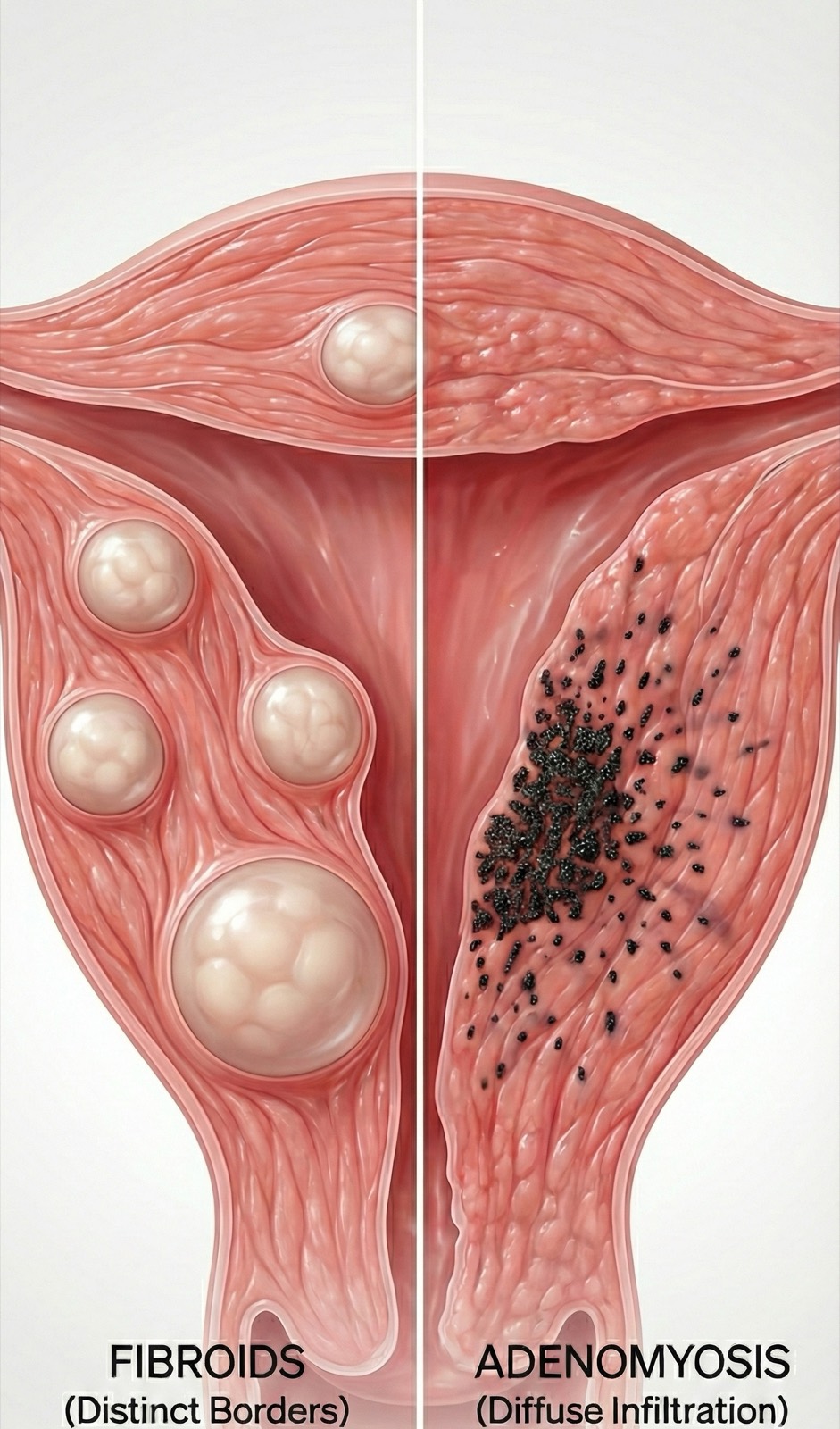
Our understanding of adenomyosis continues to progress. It is now recognized as a disease of Tissue Injury and Repair (TIAR), where the junctional zone barrier breaks down due to chronic inflammation and cellular signaling.
Adenomyosis Symptoms
Often the "missing link" in chronic pelvic pain — misdiagnosed for years as fibroids, endometriosis, or simply "bad periods."
Menorrhagia
Severe bleeding, flooding, and the passing of large clots. Often leads to debilitating anemia and chronic fatigue.
"Bulk" Symptoms
The feeling of carrying a "bowling ball" in the pelvis. An enlarged, "boggy" uterus can press on the bladder and bowel.
Dysmenorrhea
Severe, knife-like cramping that often radiates to the lower back and down the legs during the cycle.
The Endo Connection
Up to 50% of patients with deep infiltrating endometriosis also have adenomyosis. Treating one without the other is a common cause of failed surgery.
Failed Standard Treatments
Hormonal IUDs and endometrial ablation provide incomplete relief. Standard ablation can actually trap adenomyosis deeper in the muscle wall, worsening pain.
Chronic Anemia & Fatigue
Ongoing blood loss leads to persistent iron-deficiency anemia, brain fog, and exhaustion that profoundly impacts daily function.
MRI-Guided Adenomyosis Evaluation
Rejecting the guesswork that leaves adenomyosis patients undiagnosed and undertreated for years.
The Limitation of Pelvic Ultrasound
Standard pelvic ultrasound is the most commonly used first-line imaging tool, but it frequently fails to detect adenomyosis — or confuses it with uterine fibroids. This leads to incorrect surgical planning, wrong procedures, and failed outcomes.
Many patients arrive at Dr. Stepp's practice having been told they only had fibroids — and having undergone procedures that did nothing for their adenomyosis.
MRI Intelligence & Intraoperative Mapping
Dr. Stepp uses specialized Pelvic MRI with junctional zone analysis to measure the precise thickness and distribution of adenomyotic infiltration — distinguishing between focal disease (treatable with preservation) and diffuse disease (requiring hysterectomy). This advanced MRI mapping is the foundation of the pre-operative workup and surgical planning before any intervention.
During Acessa procedures, intraoperative uterine ultrasound is used to guide the ablation in real time.
How Adenomyosis May Develop: The TIAR Theory
Adenomyosis is a condition in which tissue similar to the uterine lining grows into the muscular wall of the uterus. One leading explanation is called the Tissue Injury and Repair, or TIAR, theory.
The process may begin in the junctional zone, the thin boundary between the uterine lining and the uterine muscle. Repeated minor injury in this area may result from menstruation, pregnancy, childbirth, uterine procedures, abnormal uterine contractions, or ongoing inflammation. However, adenomyosis can also develop in people without these risk factors.
Normally, injured tissue heals and returns to its usual state. In adenomyosis, the repair process may become abnormal. Inflammation, increased estrogen activity, and changes in cell signaling can weaken the normal boundary between the uterine lining and muscle. This may allow cells from the base of the uterine lining to grow into the muscle wall.
Once these cells are inside the muscle, they continue to respond to hormones. They can cause inflammation, bleeding, scar tissue, thickening of the uterine muscle, and enlargement of the uterus. These changes may lead to heavy or prolonged periods, severe menstrual cramps, pelvic pressure, pain during sex, and chronic pelvic pain.
Adenomyosis may also affect fertility by interfering with normal uterine contractions, implantation, and the environment needed to support an early pregnancy.
The TIAR theory helps explain adenomyosis as an ongoing cycle of tissue injury, abnormal healing, inflammation, and muscle remodeling. However, it is not the only possible explanation. Hormonal, immune, genetic, developmental, and other factors may also contribute.
Adenomyosis Treatment Philosophy
Treatment is never one-size-fits-all. Dr. Stepp's approach begins with precise MRI diagnosis and tailors the surgical strategy to your anatomy, goals, and lifecycle stage.
Acessa® RF Ablation
Having investigated and adopted radiofrequency ablation technologies over a decade ago, Dr. Stepp adopted Acessa early in its clinical evolution. His practice was one of the few with the surgical volume and technical skill required to master the complex early iterations of the procedure.
Today, he offers Acessa through a single-incision laparoscopic technique (SILS). Combined with laparoscopic intraoperative uterine ultrasound guidance and advanced pre-operative MRI mapping during the workup, targeted radiofrequency energy is applied to adenomyotic tissue with the goal of reducing uterine pressure and improving bleeding or bulk symptoms in appropriately selected patients.
Minimally Invasive Hysterectomy
When adenomyosis is diffuse and preservation is no longer a viable goal, hysterectomy may be the most appropriate surgical treatment. We perform this using advanced Robotic-Assisted or Scarless Laparoscopic techniques.
Clinical Clarification: A hysterectomy is the removal of the uterus only. It does not require the removal of your ovaries, and ovarian preservation is discussed when clinically appropriate. Dr. Stepp prioritizes hormonal health and ovarian reserve while planning an efficient recovery and durable treatment of uterine disease.
For patients with co-occurring endometriosis and adenomyosis, Dr. Stepp's dual-fellowship training allows both conditions to be considered in the same surgical plan — reducing the risk of a piecemeal approach.
Frequently Asked Questions
Serving Charlotte & the Carolinas
Advanced Pelvic Surgery and Urogynecology of Charlotte is located in the Ballantyne area of south Charlotte, NC — and serves as a national referral destination for complex adenomyosis cases where local options have failed.
Wondering If This Sounds Like You?
The APSU Private Concierge can answer questions about adenomyosis symptoms, fertility, uterine preservation, and what a consultation involves — instantly, before you ever pick up the phone.
General information, not medical advice. Not for emergencies. For urgent concerns, call (980) 771-0726.