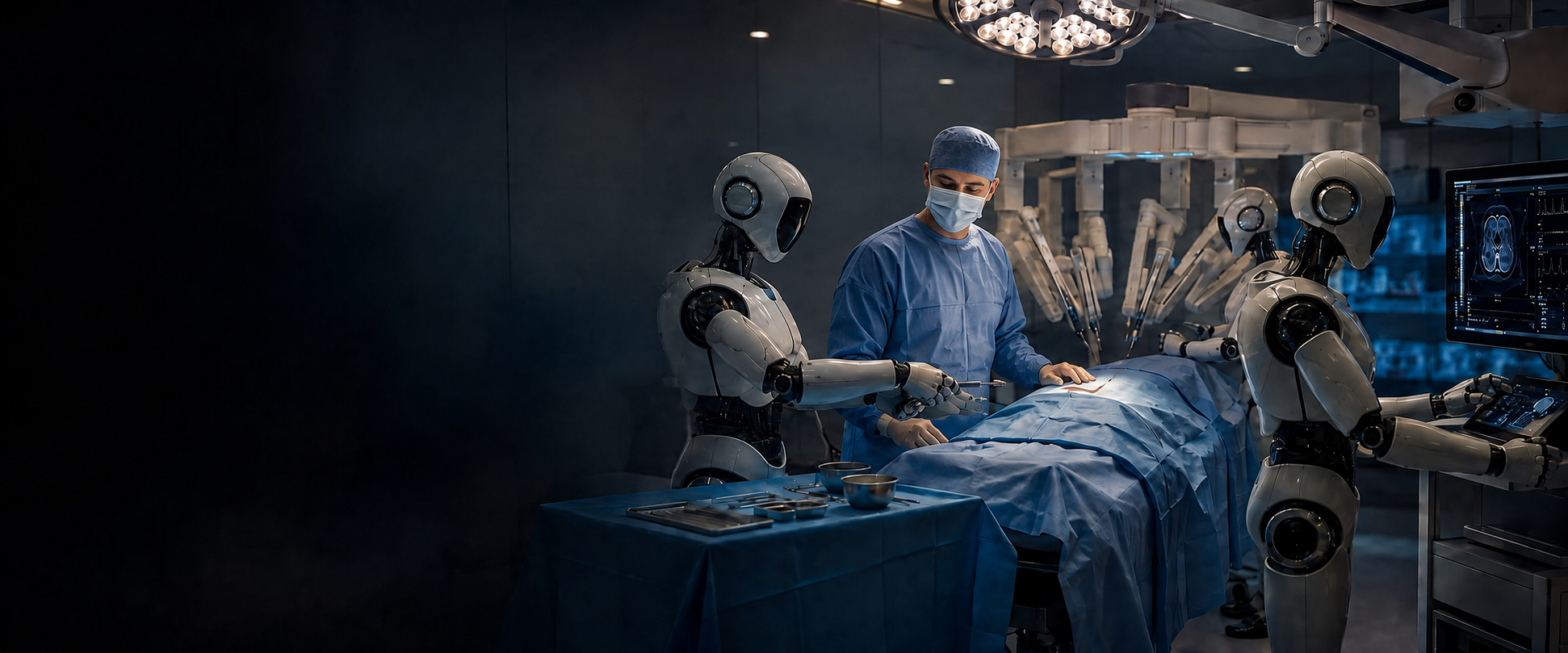
In a Moonshots conversation published January 6, 2026, Peter Diamandis asked Elon Musk when Tesla’s Optimus would become “a better surgeon than the best surgeons.” Musk answered, “Three years.” He predicted that, at scale, great robotic surgeons would outnumber human surgeons.
Then Diamandis asked, “So don’t go to medical school?”
“Yes,” Musk replied. “Pointless.”
That conversation was recorded in December 2025. As I write this in September 2026, nearly a quarter of Musk’s three-year window has passed. Progress in AI will not follow a straight line, and I would not pretend to know exactly where the steepest part of the curve lies. But the evidence available today does not yet show that a robot is on track to surpass the best surgeons across the full range of surgery by December 2028.
You can see why the prediction lands. Through shared data, a robot could learn from more operations than any surgeon could witness in a lifetime. It would not tremble, tire, or lose concentration. It could bring technical precision to places where experienced surgeons are scarce.
I don’t dismiss that future. After more than two decades in gynecologic surgery, including years developing and teaching robotic and minimally invasive techniques, I have seen how quickly tools change what is possible. My patients deserve every advantage we can safely give them.
Timelines matter, especially when the message to students is that medical school is “pointless.” Words like that have consequences. They can create fear and hesitation in young people who feel called to serve. Two of my sons are pursuing careers in medicine, and each is considering surgery. What do those of us already in medicine owe them and the thousands of young people making the same commitment?
My answer is that robots will become better than humans at many surgical tasks and may eventually perform selected procedures with extraordinary autonomy. But executing an operation is not the same as being responsible for a patient. The harder questions begin when anatomy is unclear or the operation no longer matches the plan.
01The case for roboticsWhat robots will do better
Today’s surgical robots are usually instruments under a surgeon’s control, not independent operators. They help us perform complex procedures through smaller incisions. For tasks with defined, measurable goals, a machine may eventually be more consistent than a human hand.
I saw that value in 2009, when I used a voice-controlled system called ViKY during a single-incision hysterectomy. ViKY controlled the camera and positioned the uterus, work normally performed by a bedside surgical assistant. With ViKY performing those functions, I completed the procedure without a surgical assistant. That result made the case noteworthy enough to publish. ViKY did not understand the operation or decide what should happen next. It reliably replaced defined tasks.
I would not defend human surgeons on fatigue or attention. A robotic assistant could maintain traction indefinitely, preserve the surgeon’s view, and warn that a safety margin was narrowing. If a machine can perform a defined task more reliably, I want it on my team.
Performing an operation is not the same as being responsible for a patient.
The important questions are what authority we give it and who takes over when the operation no longer matches its model.
02Perception and inferenceSeeing what is not yet visible
In my world, ureteral injury is one of the complications gynecologic surgeons fear most during a hysterectomy. This narrow tube carries urine from the kidney to the bladder. In routine surgery, textbooks teach reliable ways to find it.
But invasive endometriosis, dense fibrosis, previous operations, or cancer can erase the textbook view. Scar tissue may pull organs, nerves, and major blood vessels into abnormal relationships. The ureter may not simply be hidden. The entire landscape around it may be distorted.
Experience changes what a surgeon can see. This is more than remembering where the ureter should be. Color, texture, tension, movement, and the direction of scar tissue can reveal anatomy before it is exposed. An experienced surgeon may recognize the ureter’s margin or the promise of a safe plane from clues that look like almost nothing.
That perception, before clear visualization, guides the dissection. In severe endometriosis, cancer, or fibrosis, I may still need to free the ureter from dense scar tissue. Inference helps me judge where it lies and which plane is safest, limiting dissection to only what is necessary and reducing the risk of injury.
An operation is not a matter of advancing until every structure becomes obvious. I may begin from one side, find that the plane is unsafe, and approach from another. Sometimes the safest decision is to stop, preserve what matters most, and return another day with a different plan.
Tools and technology will be developed to make surgery safer for autonomous robots. Fluorescent dyes, advanced imaging, sensors, and computer vision may eventually identify structures and patterns too subtle for the human eye. Some of these technologies already exist in limited forms, but surgeons do not yet have an integrated system that can reliably identify hidden structures in distorted anatomy.
Medicine does not adopt new technology simply because it is possible. Hospitals must decide whether an improvement in safety or outcomes justifies the purchase price, training, maintenance, and operating-room integration. Value-analysis committees want evidence that a system reduces risk, saves money, or lowers the total cost of care per patient. That process is necessary, but it is also a real barrier between a promising demonstration and widespread use.
I am not arguing that machines can never acquire surgical perception. I am arguing that collecting millions of operative videos is not the same as mastering hidden anatomy, and three years is not a credible timeline for doing so reliably across complex patients.
A robot must do more than label a ureter once it appears. It must know when the field is unreliable, infer boundaries before they are clear, distinguish safe from dangerous planes, and recognize when obtaining more information would itself cause harm.
03Goals and judgmentWhen a technically successful answer is still wrong
An intelligent system may pursue its assigned goal after that goal has stopped serving the patient. I have seen a lower-stakes version with my own AI agents: asked to troubleshoot a problem, they sometimes changed core code or built elaborate workarounds to suppress an error. That can create layers of work-arounds. Once I understood why the error occurred, a simpler solution became obvious.
The same tunnel vision in surgery could turn a difficult problem into hours of unnecessary dissection. A surgeon might instead pause, restore the view, change direction, or choose a less aggressive solution that better fits the patient’s goals. A machine may apply exquisite precision to the wrong problem or pursue a valid endpoint at unreasonable cost.
A safe system must recognize when its working model is wrong and ask for help before confidence becomes tunnel vision.
04Consent and accountabilityThe patient still has a voice, even when she is asleep
Before an operation becomes technical, it is personal. Two patients with similar anatomy may want different results. The surgeon must understand what each hopes to change, preserve, and accept. When the patient is under anesthesia, the surgeon carries that conversation into the operating room. She cannot speak for herself at that moment. Her surgeon must.
Suppose an unexpected mass is found during pelvic surgery. A consent form may authorize “any other necessary procedure,” but that is not a blank check. Is removal necessary, or is a biopsy safer? Would proceeding sacrifice fertility or an organ the patient hoped to keep? Can the operation pause so she can decide?
Asking a machine to answer means giving it more than control of instruments. We are asking it to interpret consent, weigh values, and exercise authority over someone unable to object. Patients deserve to know who carries responsibility.
05The counterargumentThe strongest case for autonomous surgery
There is a serious argument on the other side. Given enough operations linked to outcomes, a model might encounter more anatomic variation than any surgeon ever could. It could combine video, imaging, force, instrument data, and physiology without becoming overwhelmed.
A machine need not replace the best surgeon in every circumstance to matter. In selected operations, it could outperform the average operator and extend expertise to communities that lack it. Supervised autonomy could improve care long before a robot manages an entire operation alone. I hope it does.
Millions of robotic procedures have already been performed, but a procedure is not automatically a usable training record. Video may omit force, instrument movement, the team’s reasoning, the patient’s goals, and consequences that appear months later. Those data must be captured, labeled, governed, shared, and validated across institutions. Shared intelligence can distribute what one robot learns. It cannot manufacture the missing experience. That is another reason three years is not a credible timeline.
06Work after automationSo what happens to the surgeon’s job?
The surgeon’s job will change long before it disappears. Bounded tasks with measurable goals will automate first, and some specialties will change faster than others. It would be dishonest to promise students that workforce needs will remain exactly as they are.
As machines take over more repeatable execution, the surgeon’s responsibilities will move toward choosing the right patient, setting the goals and limits of the operation, supervising automation, recognizing when reality no longer matches the plan, rescuing a case, explaining outcomes, and remaining accountable to the person who trusted the team.
I recognize that structure because it is already how I work with AI agents. I define goals and boundaries, review their work, and intervene when the output drifts from its purpose. They make me faster, but they do not assume responsibility for what I decide. The stakes in an operating room are incomparably higher, but I suspect the relationship between surgeon and surgical AI will develop along similar lines.
The future will reward surgeons who understand both what AI can do and when its confidence should not be trusted. Technical skill will still matter, but humility, communication, ethics, and judgment will matter more, not less.
07A promise to the futureWhat I would tell my sons and my patients
We should not pretend that nothing will change or surrender to one prediction as if it were settled fact. We owe future surgeons honesty about what may be automated, training to work with intelligent machines, and the ability to recognize failure and take over when necessary.
Their future in medicine will not look exactly like ours.
But it will not be pointless.
If either chooses surgery, I would say: learn anatomy thoroughly. Become excellent with surgical technology and AI. Learn how automated systems fail. Notice when the case stops matching your expectations. Understand what matters to the person whose life is briefly in your hands. Never confuse the confidence to continue with the wisdom to stop.
To a patient, I would offer a different promise. You deserve to know what part of your operation a machine will perform, who will watch it, what happens if the plan changes, and who will take responsibility if something goes wrong. Technology should strengthen that relationship, not weaken it.
This essay was created through that kind of collaboration. An AI helped me challenge weak assumptions, organize evidence, and improve the writing. But it could not decide what I owed my patients, what I truly believed, or which claims I was willing to put my name behind. That responsibility remained mine.
For the foreseeable future, I believe surgery will work the same way.
Selected sources
- Moonshots with Peter Diamandis, interview with Elon Musk, published January 6, 2026. Watch the interview.
- Anthony Cuthbertson, “Elon Musk claims robots will be better than top surgeons within three years,” The Independent, January 8, 2026. Read the article.
- S. Kane and K. J. Stepp, “Laparo-endoscopic single-site surgery hysterectomy using robotic lightweight endoscope assistants,” Journal of Robotic Surgery 3, 253–255 (2010). View the DOI.
- H. Saeidi et al., “Autonomous robotic laparoscopic surgery for intestinal anastomosis,” Science Robotics 7, eabj2908 (2022). View the DOI.
- A. Lee et al., “Levels of autonomy in FDA-cleared surgical robots: a systematic review,” npj Digital Medicine 7, 103 (2024). View the DOI.
- Intuitive, 2025 Annual Report. Read the report.